
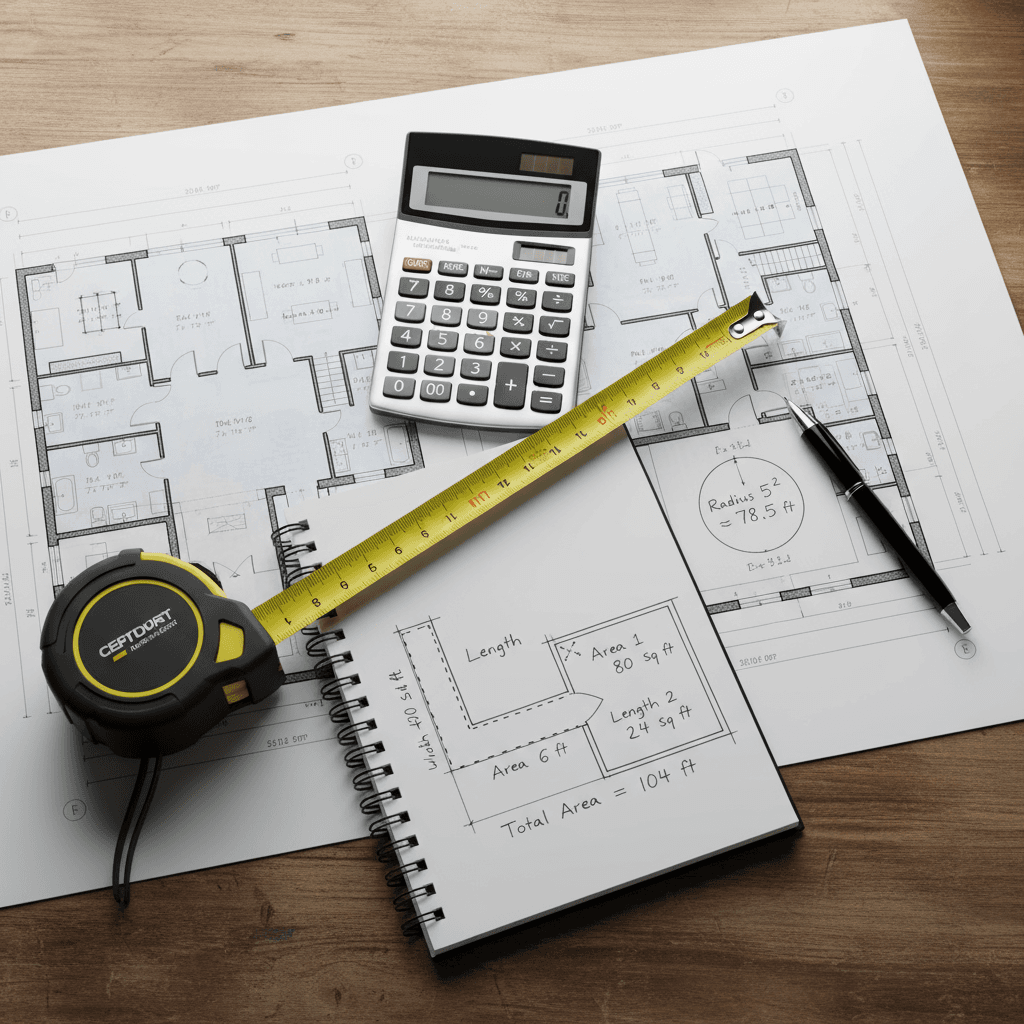

Whether you're thinking about remodeling a room, placing your furniture better, planning a painting job, or building your dream home, knowing how to measure interior size is where it all begins.
Many homeowners ask me how to do this properly, especially when they have no design experience. Don't worry—you can measure most rooms by yourself with a few tools and simple math. But for complex spaces or full homes, working with a professional (like us!) makes sure nothing goes wrong.
Let me walk you through all the steps in a super simple way.
What Is “Interior Size”?
When we say interior size, we mean the area inside a room, a wall, or an entire house. This helps in:
- Planning where furniture will fit.
- Estimating costs for paint, flooring, and lighting.
- Remodeling and renovation work.
- Creating the perfect interior design.
Tools You’ll Need
To measure your space correctly, you'll need:
- A tape measure or laser distance measurer.
- A notepad or your phone to write down numbers.
- A calculator or an app to figure out the area size.
- (Optional) A smartphone measuring app like Measure (iOS) or AR Ruler.
How to Measure a Regular, Rectangular Room
This is the easiest way to get started!
Step-by-step:
- Measure the length – from one wall straight across to the opposite one.
- Measure the width – perpendicular to the length.
- Multiply: Length × Width = Area
Example:
If the room is 12 feet long and 10 feet wide, the area is:
- 12 ft × 10 ft = 120 square feet
Converting Inches:
If your result is in feet and inches, change inches into decimals.
Tip: 6 inches = 0.5 feet.
So, 10 feet 6 inches = 10.5 feet.
Measuring Irregular-Shaped Rooms
Many Bangladeshi homes, especially in Dhaka or Chattogram, don’t have square rooms. Here's how to measure odd-shaped areas:
- Sketch the shape on paper first.
- Divide the room into simple rectangles or squares.
- Measure each section’s length and width.
- Multiply and calculate each area.
- Add them all to get the total square footage.
Example: “L” Shaped Room
Break it into Part A and Part B, measure each, then:
A = 10 ft × 8 ft = 80 sq. ft B = 6 ft × 4 ft = 24 sq. ft
Total = 104 square feet
How to Calculate the Interior Size of a House
Measuring a whole house takes time. Here's how I do it as a pro:
- Draw a rough floor plan of each floor.
- Break down the house into rooms (kitchen, living room, baths, closets, hallways).
- Measure each room separately.
- Add up the size of all finished spaces.
- (Don’t count garages, patios, or unfinished basements.)
The final total is the interior size of your home.
Learn More: Budget-friendly House Design Ideas
Measuring Wall Size for Paint, Wallpaper, or Paneling
This is especially useful if you’re planning to paint or decorate your walls.
The Easy Formula:
Wall Height × Wall Width = Wall Area
But don’t forget to subtract doors or windows.
Example:
Wall size = 12 ft wide × 10 ft high = 120 sq. ft One door = 15 sq. ft 120 – 15 = 105 square feet to paint 121.
Common Mistakes to Avoid
Over the years, I’ve seen many homeowners make these errors:
- Forgetting to convert inches (6 inches = 0.5 ft).
- Only measuring from midpoints—not the widest areas.
- Adding in garage or unfinished space.
- Not double-checking—small mistakes grow in big projects.
When in doubt, measure twice
Learn More: Top 10 Mistakes People Make When Building a House
Helpful Digital Tools & Apps
Technology can make life easier!
- iPhone’s Measure App or Android’s AR measuring tools
- Online calculators can quickly give the square footage
- Design apps can sketch and measure rooms
Note: These tools are fast, but not always accurate. For anything important (especially designing), I recommend professional measuring to avoid costly errors.
Why Hire a Professional Interior Designer
While you can take basic measurements yourself, a professional makes sure the details are just right.
As an expert interior designer here in Bangladesh, I can:
- Take perfectly accurate measurements with laser tools.
- Handle odd-shaped rooms quickly.
- Use 3D layouts and design software.
- Prevent costly mistakes—like ordering a sofa that doesn’t fit.
- Save your time, money, and stress.
Learn More: What Does an Interior Designer Do
Final Thoughts
To sum it all up:
- Measure length × width for square or rectangular rooms.
- Break complex rooms into smaller areas.
- Add up all finished area sizes for the whole home.
- Remove doors/windows when calculating wall area.
Measuring is the first step. But turning those numbers into a well-designed, cozy, and stylish home? That’s our job at Archiconnect!