
Middle tier architecture is the part of a system that handles the main work—like the rules, decisions, and actions—between the user interface and the database. It’s where your app “thinks” before giving an output.
In short: It’s the brain of an app, sitting between what users see (the front) and where data lives (the back).
Hi, I’m a professional architect and the founder of Archiconnect, Bangladesh’s own buildtech platform. While I usually work on designing smart buildings and future-ready infrastructures, modern software architecture shares a surprising amount in common with building architecture.
Both need structure, clarity, and separation of parts. That’s why understanding something like “Middle Tier Architecture” can help not just software engineers, but smart builders and architects like us too.
Let’s break it all down in a simple, useful way.
What Middle Tier Architecture Means
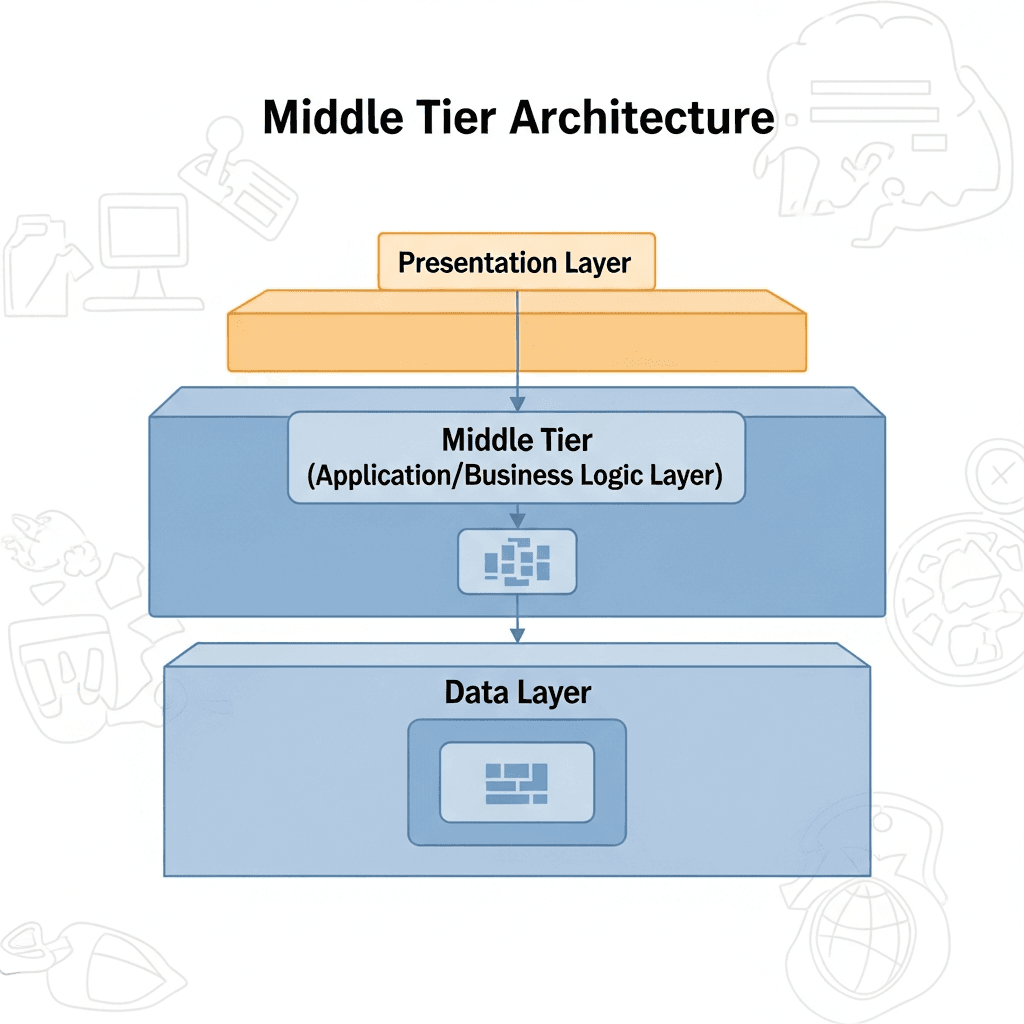
Think of a modern digital system like a three-layer cake:
- Top layer (Presentation Tier): What users see and interact with—like a website or app screen
- Bottom layer (Data Tier): Where the data is stored—like a database
- Middle layer (Middle Tier): The logic layer—handles actions, rules, and connects the other two
The Middle Tier is like a manager. It tells the system what to do, how to do it, and when to fetch or update data.
While we’re using the word “architecture,” this is totally different from physical or building architecture. But the idea of layers, structure, and scalable design stays the same.
So, What Is Middle Tier Architecture?
The Middle Tier is the logic layer of a software system.
- It takes orders from the UI (like when you click “Buy Now”)
- Runs the logic (like checking if the item is in stock and calculating tax)
- Sends or gets data from the database securely
- Then sends the results back to the front (like “Order Placed”)
This is where all the business rules, workflows, decisions, and real work happen.
Middle Tier in a 3-Tier Model
In a 3-tier architecture, you have:
- Presentation Tier: Website, app, or dashboard -** Middle Tier:** Application logic -** Data Tier:** Database or storage
Middle Tier’s job?
- Gets actions from users (like uploading a photo)
- Applies backend rules (is the photo allowed?)
- Talks to the database (to store the photo info)
- Sends feedback to the user (photo uploaded successfully)
It’s like a bridge with rules between users and data.
Key Jobs of the Middle Tier
Here’s what the middle tier actually does:
Business Logic Processing
- Follows rules (e.g., minimum order amount)
- Runs calculations (e.g., tax, discount, shipping)
- Follows workflows (e.g., user signup steps)
Handles Requests
- Listens to requests from the app or website
- Talks to APIs and web services
- Does validations (is the email valid?)
Connects to Data
- Sends and receives data from the database
- Keeps database secure—users never talk to the database directly
- Updates info safely
Manages Workflows
- Makes sure steps happen in order (register > email > approval)
- Keeps data consistent through multiple steps
What’s Inside the Middle Tier?
Here are common tools and building blocks used in this layer:
Application Servers
- Run business logic
- Examples: Java EE servers, .NET servers
Web Servers (Support Role)
- Direct traffic, balance load
- Examples: Apache, Nginx
Middleware
- Connects services and layers behind the scenes
- Examples: Message queues, service buses
Microservices
- Tiny apps that each do one job
- Example: One microservice handles user login, another handles payments
Real-Life Examples of Middle Tier Architecture
E-Commerce Website
You click “Place Order”:
Middle Tier:
- Confirms your account
- Calculates tax and shipping
- Checks item availability
- Sends everything to data tier
Enterprise Dashboard
You request team data:
Middle Tier:
- Checks your role (are you allowed?)
- Calls database
- Sends back only the info you're allowed to see
Middle Tier vs N-Tier
A 3-tier system has:
- 1 UI layer
- 1 logic (middle) layer
- 1 database layer
N-tier architecture adds more layers:
-
Maybe a separate security layer, API layer or reporting tier
-
Use 3-tier if your system is simple and structured.
-
Use N-tier when your system is large, complex, and growing.
Middle Tier in SQL-Based Systems
In systems using SQL databases:
- Logic can be split between stored procedures and middle tier
- But most business logic should be in the middle tier, not the database
Why?
- Easier to manage and update
- Keeps the database safe
- Better performance and security control
Benefits of Middle Tier Architecture
Scalability
- Add more servers to middle tier—no need to change front or back
Security
- Middle tier acts as a shield—stops direct access to database
Flexibility
- Change design/front-end or database without rewriting logic
Reusability
- Can use the same logic for mobile, web, and APIs
Common Use Cases
- Web and e-commerce systems
- Mobile apps with backend logic
- ERP and enterprise tools
- Cloud-based services
- Smart buildings and automation systems (like we use at Archiconnect)
Why It Matters in Modern Design
- Middle tier supports clear structure, separation of logic, and future growth.
For architects like me, this thinking resonates:
- Plan with layers (like blueprinting a building)
- Separate responsibilities (like plumbing vs electric)
- Design for the future (expand when needed)
Conclusion
The middle tier is the core engine of any digital system. It:
- Runs your business rules
- Manages requests
- Talks to data safely
- Keeps everything connected but separate
It’s essential for strong, secure, and scalable systems—just like a well-planned building. At Archiconnect, we follow the same principles in smart buildings: system-driven, logical, and future-ready. Whether it’s a structure or a system, good architecture always starts with a solid middle.
FAQs
What is the middle tier in architecture?
The middle tier in architecture, also known as the application tier or logic tier, is the layer that handles the core business logic, data processing, and communication between the front end (user interface) and the back end (database).
It processes user inputs from the client tier, interacts with the data tier, and returns the results to the presentation tier.
What is a middle tier?
A middle tier is the intermediary layer in a multi-tier architecture that manages application logic, business rules, and communication. It separates the user interface from data storage to improve scalability, maintainability, and security.
It can include application servers, APIs, or services that handle operations like authentication, data validation, and transactions.
What is n-tier architecture?
N-tier architecture (also known as multi-tier architecture) is a software design model that separates an application into multiple logical layers or "tiers." Each tier has a specific responsibility, promoting better organization, scalability, and reusability.
Common tiers include:
- Presentation tier: User interface
- Application (middleware) tier: Business logic
- Data tier: Database or data storage
The "n" represents the number of tiers, which can vary based on the system's complexity (e.g., 3-tier, 4-tier, or more).
What are the 5 levels of architecture?
The "5 levels of architecture" can vary depending on the context (software, enterprise, IT, etc.), but in enterprise or software architecture, a common breakdown is:
- Business Architecture – Defines business strategy, governance, organization, and key business processes.
- Information Architecture – Organizes and standardizes data and information assets across the enterprise.
- Application Architecture – Structures applications and services to support business functions.
- Technology (or Infrastructure) Architecture – Covers the hardware, software, and networks that support applications.
- Security Architecture – Ensures systems and data are protected across all other architectures.
These levels provide a holistic view of an enterprise's systems and how they work together.