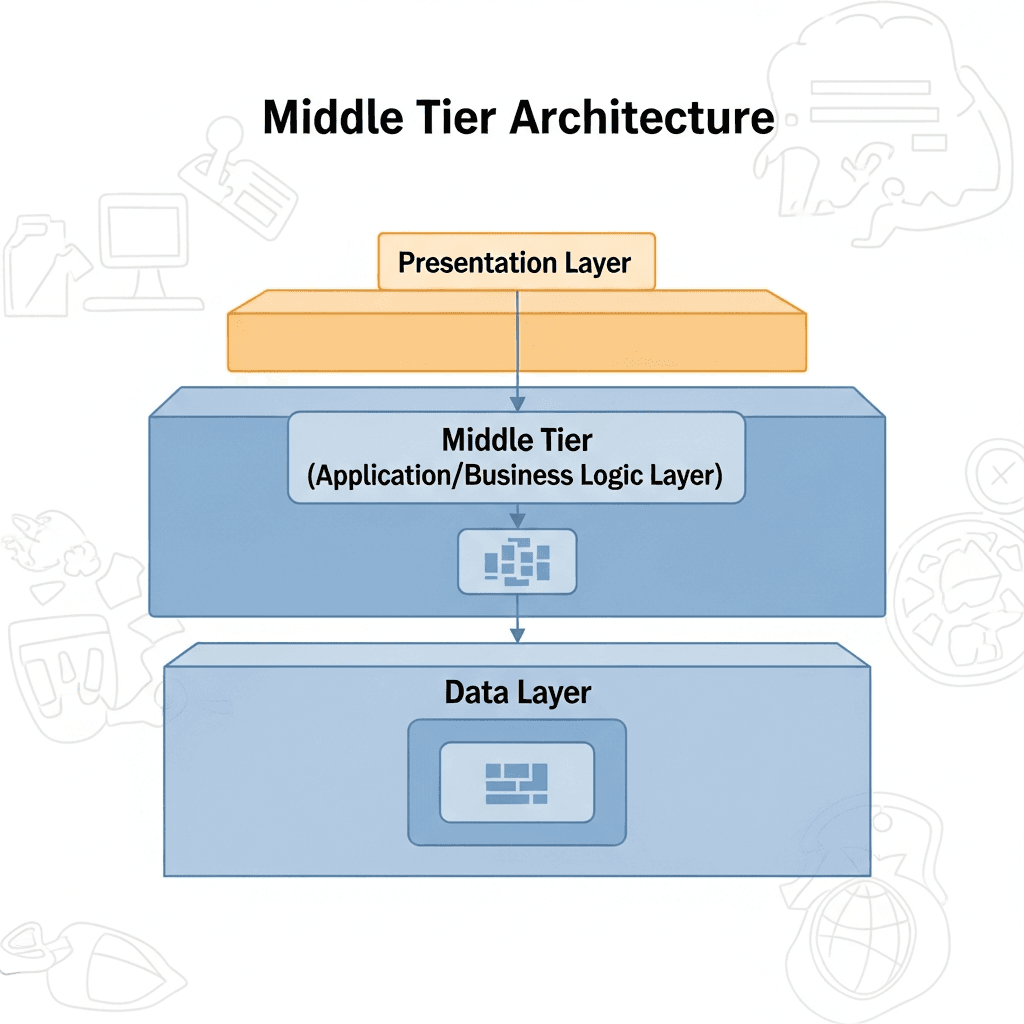


N Architecture is a way to design systems in layers or “tiers,” where each part has a clear job.
In N Architecture, the “N” means any number of layers—not just 3 or 4. These layers are stacked like floors in a building, and each one works on a different task.
It’s used in system software and digital platforms, not in physical buildings—but the thinking is similar. Just as an architect like me plans layers in a building (like foundation, walls, and roof), system architects plan code and functions in clean, separate portions.
Note: Don’t confuse this with architectural design for houses and buildings—though the core planning is actually quite alike!
What Is N-Tier Architecture?
N-Tier Architecture is a system structure where tasks are split into separate layers that each handle one responsibility.
Each "tier" or "layer" focuses on its own job:
- One shows the interface (what users see)
- One handles logic and rules
- One manages data and storage
These layers don’t mix roles, and they talk to each other in order—just like a building team where electricians, plumbers, and masons do their own parts.
Think of it like this: You don’t let users touch the database directly. The logic layer decides what data they can access or change.
Key Principles of N Architecture
This structure depends on a few core rules:
Separation of Concerns
Each layer should only do one job. For example:
- The UI (frontend) handles display and user input.
- The Logic layer checks rules.
- The Data layer talks to the database.
Layer Independence
- Layers should not depend too much on each other.
- The UI doesn’t jump directly into the database. Instead, the Logic layer controls every action.
Scalability
- You can improve or grow one part (like the database) without changing the entire system. This makes growth smoother.
Maintainability
- Every section is easier to fix, update, or replace. No need to redo everything when making one change.
Common Layers in N-Tier Architecture
Let’s look at the most common layers you’ll find in an N-tier system:
1. Presentation Layer (UI)
- This is what users see—websites, apps, dashboards.
- It shows data and takes input from users.
2. Business Logic Layer
- This is the brain of the system.
- It checks rules, follows workflows, and makes decisions.
3. Data Access / Persistence Layer
- This layer talks to the database.
- It saves and retrieves data while keeping it secure.
Optional Layers:
- Service Layer: Connects APIs and external systems
- Integration Layer: Links to third-party apps
- Security Layer: Handles logins and permissions
N-Tier vs 3-Tier Architecture
3-tier is just a simpler example of N-tier with only 3 layers.
In 3-tier, you’ll typically have:
- Presentation (UI)
- Business Logic
- Data layer
In N-tier, you can add more layers as needed—for services, integration, security, etc. It’s more flexible for complex systems.
N-Tier Architecture Example: Online Service Platform
Let me give you a simple example.
Imagine you use an online service—like applying for a building permit.
- You fill up a form on the website (UI Layer)
- The system checks if your home location supports that permit and if your design qualifies (Logic Layer)
- It saves your form in a secure database (Data Layer)
- Then it may send it to a government system (Integration Layer)
Each part of this process happens in its own tier.
Logical vs Physical N Architecture
Logical N Architecture
- This is in the software code.
- All layers exist separately—but might run on the same server.
Physical N Architecture
-
Here, each layer is hosted on different machines or servers.
-
Improves speed, security, and reliability.
-
[ ] Logical = separated in design
-
[ ] Physical = separated in deployment
N-Tier vs Microservices
N-tier systems are layered; Microservices are separate mini-systems.
- N-tier systems follow a central structure with clear layers.
- Microservices break apart the system into mini-apps, each with its own job and database.
Choose N-tier when:
- You have a mid-sized or large system with central controls.
- You want clear layers for structure and security.
Choose Microservices when:
- You want flexibility and independent teams.
- Many big systems actually mix both.
Where Is N Architecture Used?
This structure is everywhere!
- Business apps
- Cloud platforms
- Banking and hospital systems
- Smart city and automation platforms
Why? Because they need to be stable, secure, and easy to grow over time.
Benefits of N Architecture
Let’s sum up the good parts:
- Clarity – You know what layer does what
- Security – Attackers can’t jump straight to data
- Scalable – Easy to grow or upgrade
- Maintainable – Easier to fix and manage
Challenges and Considerations
But it’s not perfect.
Here’s what to watch out for:
- Can get complex if you add too many layers
- May slow down if not well-designed
- Needs strong planning from the start
That’s why professionals like us spend time mapping the structure before building anything.
Why N Architecture Reflects Real Architectural Thinking
As an architect, I see a clear connection between building design and system design.
Both need:
- Clear structure
- Planning for future expansion
- Scope control
- Organized layers
That’s why N Architecture is so useful. Whether it’s homes or systems, good architecture always makes life easier.
Final Words
To wrap up:
- N Architecture is a way to plan systems in neat, well-defined layers.
- It makes software strong, secure, and scalable—just like a well-designed building.
At Archiconnect, we apply architectural thinking to both physical spaces and digital platforms.
If you’re building a system or structure that needs to last and evolve, let us bring our layered approach—and years of experience—to your project.
Let’s build something smarter, together.
FAQs – Quick Answers
What is an N-tier architecture?
It’s a layered system design where each layer (UI, logic, data) does its own job. The "N" means any number of layers.
Is N-tier architecture still used?
Yes, especially in enterprise systems, government services, and cloud-based apps. It’s stable, structured, and reliable.
What are the advantages of N-tier architecture?
It’s clear, scalable, secure, and easier to maintain over time.
What is the difference between 3-tier and N-tier?
3-tier is a specific example with 3 layers. N-tier is the general model, and it can have more layers as needed.