
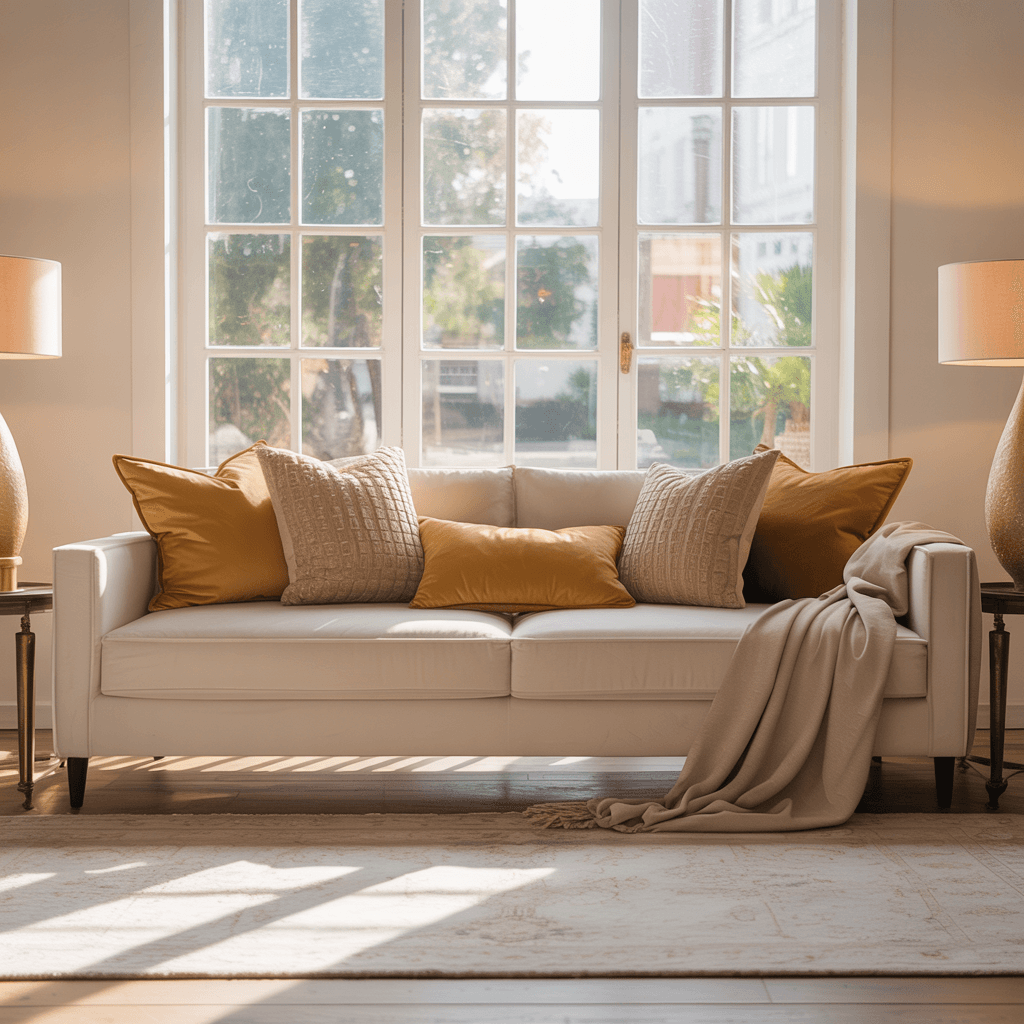

Today, I want to walk you through something we often call the “Golden Rule” of Interior Design.
Here’s the thing—there isn’t just one golden rule. Instead, there are a few key design principles that work together to bring out the best in your space. These rules come from art, nature, and even math—and when you apply them well, your home looks and feels more natural, comfortable, and visually pleasing. Let’s break them down in a simple, easy way.
The Golden Ratio (1:1.618) – The Classic Rule of Proportion
The Golden Ratio is a math formula (1:1.618) we find all over nature—in flowers, seashells, and even in buildings. It’s all about the perfect balance between parts of a whole.
How do we use this in interior design?
- Room Layouts: Divide your room using a two-thirds to one-third ratio. For example, your sitting area could take up two-thirds, and your reading nook the remaining one-third.
- Furniture Sizing: If your sofa is 6 feet long, your coffee table should be about two-thirds that length (around 4 feet).
- Wall Art: Hang art that covers about 60% of the wall space instead of crowding it.
Example: In a living room, I might place a sectional sofa that takes up two-thirds of the room and a side table or reading chair in the remaining third. It feels balanced without being overly perfect.
Learn More: 7 Concepts of Interior Design
The 60-30-10 Rule – Easy Formula for Color Balance
This rule helps you decide how much of each color to use in a room.
- 60% = Main color (walls, flooring, big furniture)
- 30% = Secondary color (like curtains, chairs, mirrors)
- 10% = Accent color (pillows, vases, artwork)
Example: In one client’s living room, we used white walls and flooring (60%), navy blue furniture (30%), and gold accents (10%). The space felt calm yet lively.
This color ratio makes rooms feel layered and well-thought-out, without looking too busy or too plain.
Learn More: House Design Ideas for Bangladesh
The Rule of Thirds – For Visual Interest
This idea comes from photography. Picture a grid of 9 equal boxes over a space—3 across and 3 down.
How to use it:
- Place important things—like a light fixture or artwork—where those lines cross.
- Group items in odd numbers. Three vases or five picture frames will look more natural than two or four.
- Aim for asymmetry, not just symmetry. Balanced items that aren’t exactly the same make the design more dynamic.
Example: Instead of placing all artwork centered perfectly on a wall, try arranging a gallery wall using the grid. It adds movement and keeps the eyes curious.
Why Do These Rules Work So Well Together?
Each rule plays a role.
- The Golden Ratio keeps everything in proportion.
- The 60-30-10 rule manages color, so the room feels pulled together.
- The Rule of Thirds adds visual energy, making the room interesting and alive.
Use them together, and you’ll have a space that looks like it came out of a design magazine—even if it’s your small studio or apartment.
Common Mistakes to Avoid
Let me be honest—many homeowners and even new designers get stuck here:
- Wrong scale: Big furniture in tiny rooms or everything too small in large rooms.
- Too many accent colors: It gets loud, not lively.
- Overdoing symmetry: Perfect alignment isn’t always better. Balance is key.
- Ignoring function: A room should not only look good but work well for how you live.
How to Use the Golden Rule in Real Homes
Let me give you a few practical examples:
- In small spaces, follow the Golden Ratio to arrange furniture and lighting—it makes the room look more open.
- In open-plan homes, use rugs and furniture to define zones in two-thirds to one-third layout.
- In studio apartments, place your couch, coffee table, and artwork using these proportions to create a “living zone” that feels cozy and styled.
At Archiconnect, we apply these rules every day in homes all across Bangladesh—whether it’s a small flat in Dhaka or a large duplex in Chattogram.
Why Work with a Professional Interior Designer
When to follow the rules… and when to break them? That’s where I come in as your designer.
- I can measure and plan layouts using digital tools like CAD and 3D room planners.
- I also bring an eye for comfort—making sure it not only looks amazing but lives well.
- I apply centuries-old principles but always update the look for your lifestyle and taste.
Learn More: How to be an Interior Designer
Conclusion
To wrap it up:
The “Golden Rule” in interior design isn’t just one rule—it’s a set of smart, time-tested techniques like:
- The Golden Ratio (for proportions),
- The 60-30-10 rule (for color),
- And the Rule of Thirds (for layout and feel).
Used together, they build spaces that look right, feel right, and work well.
If these ideas feel a bit overwhelming, don’t worry—that's what we're here for. Let’s design your dream home with professional designers, using rules that connect beauty with purpose.
FAQs
Q: What is the golden ratio in interior design with example?
A: The golden ratio, 1:1.618, helps keep things in proportion. Example: If your sofa is 6 feet, the coffee table should be about 3.7 feet.
Q: How do you apply the 60-30-10 rule in a living room?
A: Use 60% for walls and floors, 30% for furniture or curtains, and 10% for decorative accents like throws or art.
Q: Is the golden rule in interior design still relevant in 2025?
A: Absolutely! Good design never goes out of style. These rules are timeless and still guide modern interiors today.
Q: What’s the difference between the golden ratio and the rule of thirds?
A: The golden ratio is a math principle about proportion; the rule of thirds is about layout and where to place key objects visually.
Q: What is the golden rule of interior design?
A: It’s not just one rule—it's a blend of principles (like proportion, color, placement) that make a space look balanced and pleasing.
Q: What is the 60-40 rule in decorating?
A: It’s a simplified version where 60% is dominant design/color and 40% is the secondary element. Less precise than 60-30-10, but still useful.
Q: What is the golden ratio in room size?
A: Try designing a room where the length is 1.618 times its width—for example, a room 10 feet wide would be 16.18 feet long.
Q: What is the 70-20-10 rule in interior design?
A: Similar to 60-30-10, it uses 70% for dominant color, 20% secondary, and 10% accents. It’s just another mix to guide your coloring.